![Kara Connect - Logo A - RGB - White.png]](https://support.karaconnect.com/hs-fs/hubfs/Kara%20Connect%20-%20Logo%20A%20-%20RGB%20-%20White.png?height=40&name=Kara%20Connect%20-%20Logo%20A%20-%20RGB%20-%20White.png)
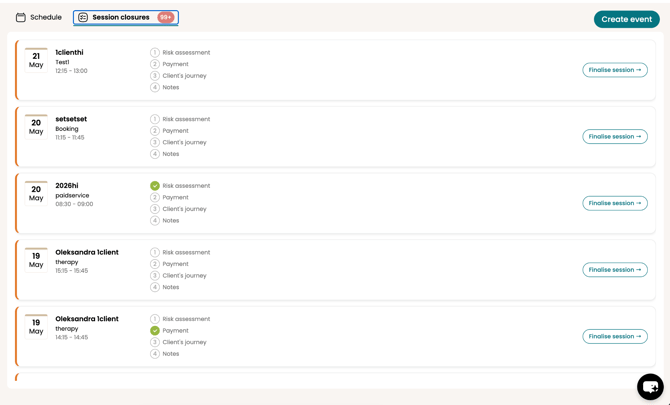
When a session ends, open it from your Sessions list and tap Close session. A side panel opens with four collapsible steps. Each step saves independently — you won’t lose progress if you step away. Only the risk observation is required; everything else is optional.
The four steps:
-
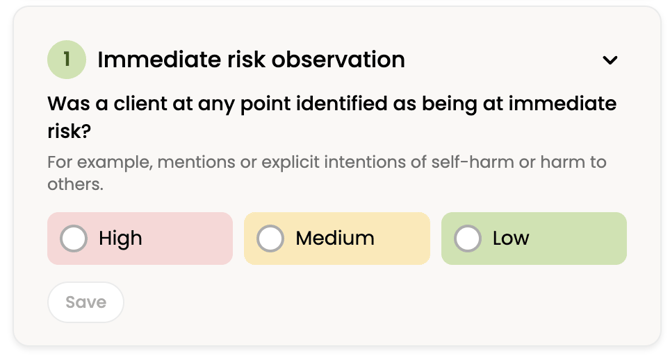
Risk observation Choose from None, Low, or Elevated. If you select Elevated, a safety plan field appears where you can document the plan, emergency contacts, and actions taken. Hit Save and the step collapses with a confirmation badge.
-
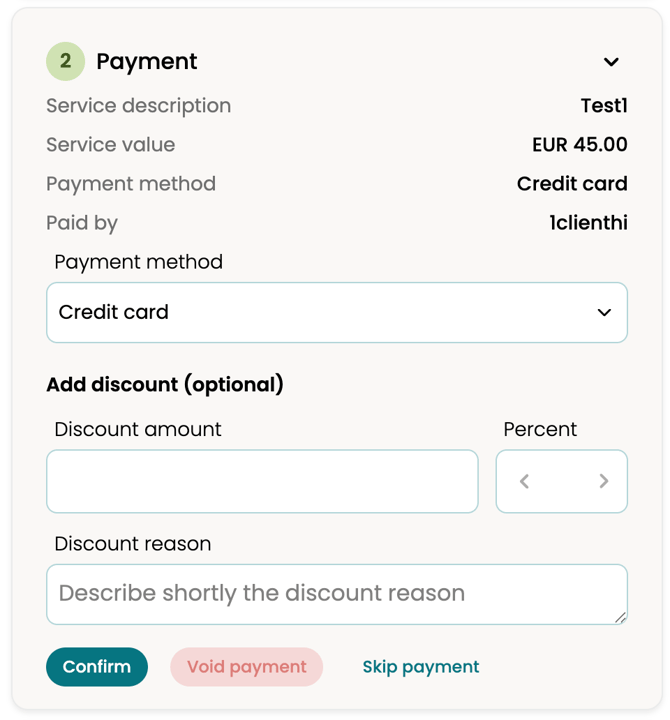
Payment For credit-based Wellbeing Hub sessions, this confirms automatically. For private sessions, select a payment method and confirm. You can apply for a discount with a reason if needed.
-
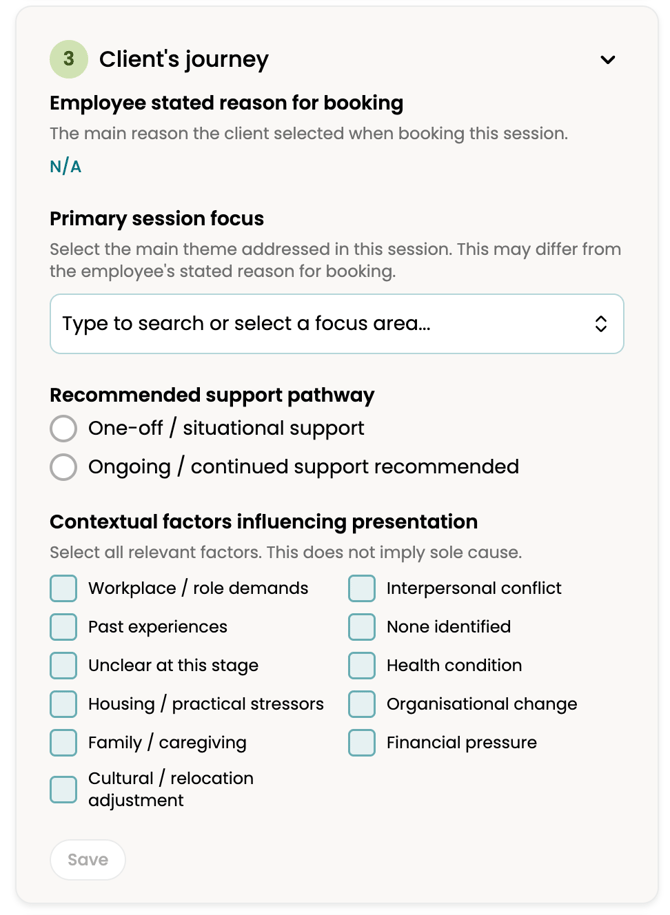
Client’s journey Three quick fields that take about 30 seconds:
-
Primary session focus — the main theme you worked on (e.g., Anxiety, Workplace Stress, Burnout)
-
Recommended support pathway — where this client is heading next
-
Contextual factors — external pressures present (Workplace demands, Financial pressure, Family/caregiving, and others). Tick all that apply
-
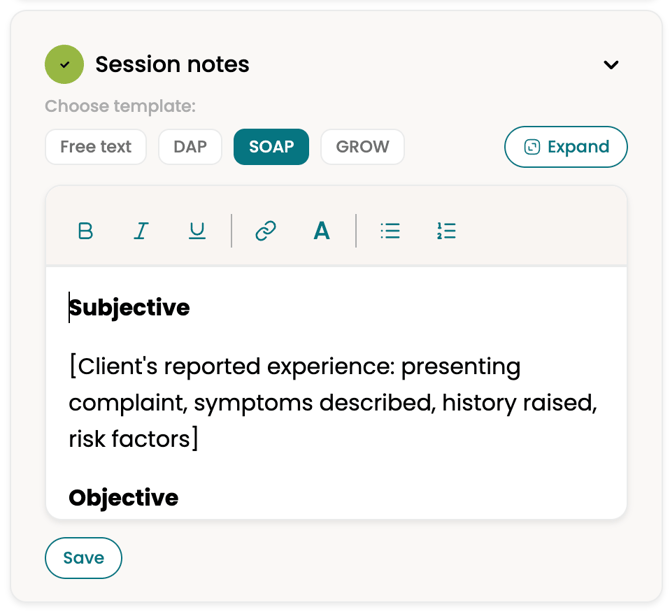
- Session notes Write your clinical notes using a format that fits your practice:
- Free text — blank page, write however you like
- DAP (Data, Assessment, Plan) — structured therapy template
- SOAP (Subjective, Objective, Assessment, Plan) — clinical format
- GROW (Goal, Reality, Options, Will) — coaching template
If you took notes during the session, they’ll be pre-filled here — just review and refine.
Once the required steps are saved, tap Finalise and you’re done. You’ll see options to schedule a follow-up, create a goal, or return to your session list.
Common questions:
-
How long does it take? Most practitioners settle into a rhythm of 2-3 minutes per session after the first week. If you take notes during the session using the in-session panel, it’s even faster — your jottings pre-fill the notes step.
-
What if my client didn’t show up? Toggle Mark as no-show at the top of the panel. Confirm payment (the session is still billed) and click Confirm cancel session. Notes, risk, and journey steps are skipped automatically.
-
Do I have to fill out every field? No. Only risk observation is required. Notes, client journey, and payment can be skipped or completed later. Use what’s useful for your practice.
-
What are the note templates? Four options: Free text for unstructured notes, DAP and SOAP for therapy, and GROW for coaching. Every field within a template is optional — they give you structure without forcing a format.
-
What should I put for contextual factors? These are broad strokes, not a diagnosis. Tick what’s obviously present and move on. “Unclear at this stage” is a perfectly valid choice, especially early in an engagement.
-
Who can see my session notes? Only you and your organisation. Notes are end-to-end encrypted and never shared with the client, the employer, or Kara Connect staff.
-
Who can see the client journey data? Client journey data (focus areas, contextual factors, support pathway) feeds aggregate clinical reports only. It is never shown at the individual client level to employers. HR managers see anonymised workforce trends, not individual sessions.
-
What happens to the data I enter? Everything you capture builds your Practice Insights — a personal dashboard showing your aggregate clinical outcomes, focus area patterns, and care continuity over time. The more precise you are here, the more useful your insights become.
-
Is risk observation data shared? Risk observations at the None and Low level are visible only to you and your organisation. Elevated risk flags are visible to your organisation’s care team to support appropriate follow-up.
-
Can I edit a closed session? You can update notes and journey data after finalisation. Risk observations and payment cannot be changed once saved.